Looking Beyond the Block
One of the things I’ve always loved about quilts is that they reveal themselves in layers.
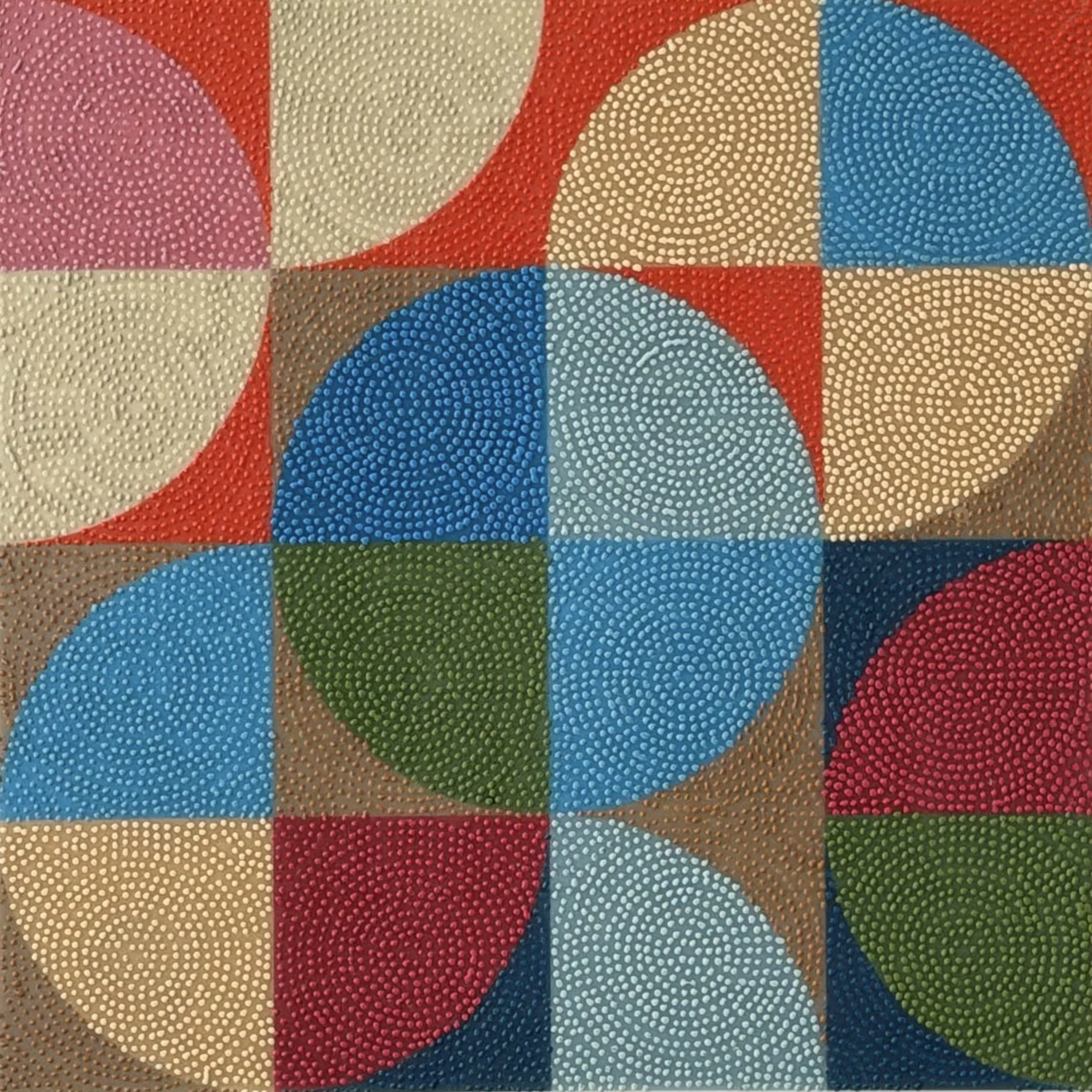
At first, you notice the pattern. In my case, I’ve been drawn to the Drunkard’s Path block for years. There’s something endlessly satisfying about the conversation between the graceful arcs and the underlying grid. Much of my own work has focused on celebrating that relationship, with my mark-making reinforcing the geometry of the design.
But lately I’ve been paying attention to something different.
For people who don’t quilt, it’s easy to think the design ends once all the pieces are sewn together. In reality, that’s only part of the story. The quilting stitches themselves become another design element.
One common approach is called stitch in the ditch, where the quilting follows the seams of the pieced blocks. The stitches are almost invisible, quietly emphasizing the geometry that’s already there.
Another approach is to ignore the seams altogether.
Instead, a quilter may stitch one continuous pattern across the entire surface—a field of spirals, feathers, loops, or meandering lines that flows over every block. The quilt pattern is still there, but now it’s joined by another layer that creates its own rhythm, texture, and movement.
That idea has been rattling around in my head for a while.
Traditionally, my Drunkard’s Path paintings have highlighted the circular arcs. The stippling reinforced the curves and helped define the individual shapes. But in this newest piece, I decided to try something different. Rather than responding to each block, I let the stitch pattern move continuously across the entire composition, almost as if the whole painting had been quilted after it was assembled.
It’s a subtle shift, but for me it feels like an important one.
Instead of simply referencing a quilt pattern, I’m beginning to borrow from the language of quilting itself. The mark-making is no longer just describing the shapes beneath it. It has become its own layer of the composition, creating another conversation that floats above the geometry.
That’s one of the things I enjoy most about working in a series. The familiar structure gives me permission to ask, What happens if…? Sometimes the answer is just a small variation. Other times it opens the door to an entirely new direction.
I have a feeling this may be one of those doors.